
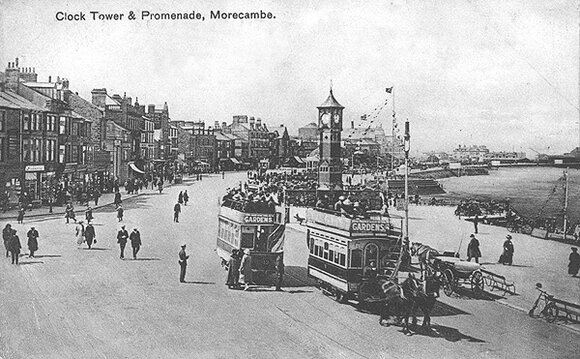
100 years ago, on 6th October 1926, the last English municipally owned horse-drawn tramway closed down in Morecambe. This occurred just before Morecambe Corporation replaced the 2½ mile route along the seafront with open-topped double deck Guy motor buses. The final tramcar was driven by the same driver – Mr Jack Birch – who had driven Morecambe’s first horse-drawn tramcar in June 1887. It was pulled by the two oldest horses in the stable – Adam and Eve – and both the Mayor and a fellow Alderman took turns at driving it. Several hundred people turned out to watch as the horses put on a final spurt on the return journey. They were even said to have exceeded the tramway’s five miles per hour speed limit!

This put an end to just over forty years of continuous horse tram operations in Morecambe, which began when Morecambe Tramways Company opened an initial section of line between the Central Pier and the Battery Hotel on 3rd June 1887. This was followed by an extension on 19th May 1888, southwards to Strawberry Gardens, which lay entirely within the neighbouring borough of Heysham. This was followed soon afterwards by a short extension northwards from the pier to East View. One final short extension, northwards to Bare, was constructed by Morecambe Corporation in 1898. This was to be operated by the Company on a ten-year lease, which brought the tramway to its maximum length of just under 4 miles.
The company acquired a fleet of 11 vehicles over the next decade or so from local constructors Lancaster Railway Carriage & Wagon Company, nine of which were open-topped double deckers and two were toastracks. Four more double deckers were acquired around the turn of the century from unknown suppliers.
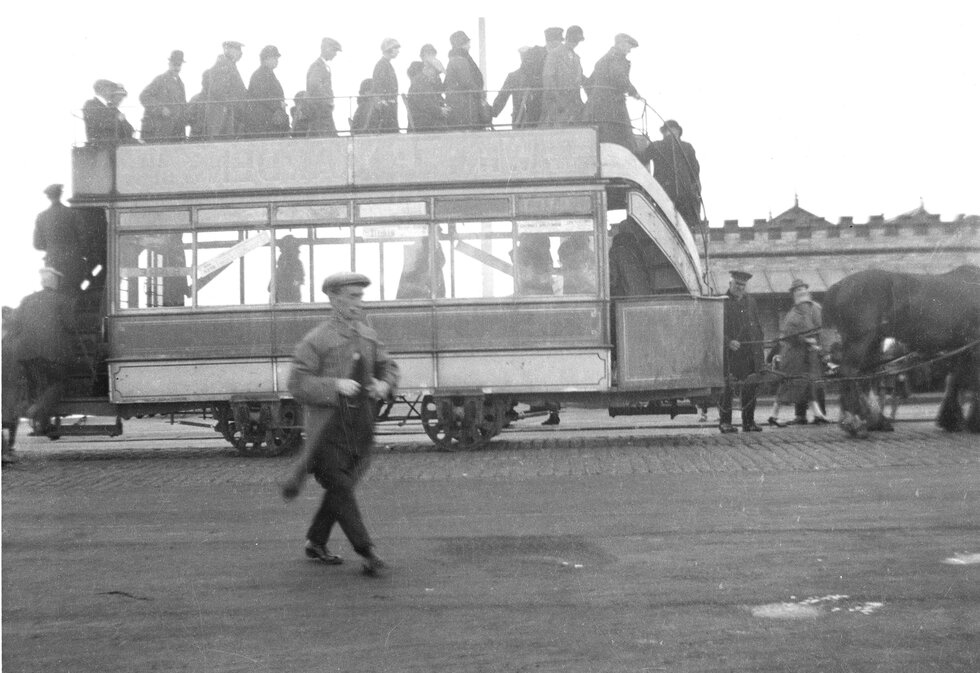

After operating profitably during its first decade, the corporation was threatened with a takeover of the company by a conglomerate led by George Balfour (of Balfour Beatty fame). It responded by exercising its option to purchase the 1½ mile section of the tramway that lay within the Morecambe municipal boundary, together with fourteen of the company’s seventeen-strong tramcar fleet and part of the depot. The remaining three tramcars were also transferred to the Corporation in 1913 when the company decided to replace them with petrol-driven tramcars on its remaining short stretch of line.
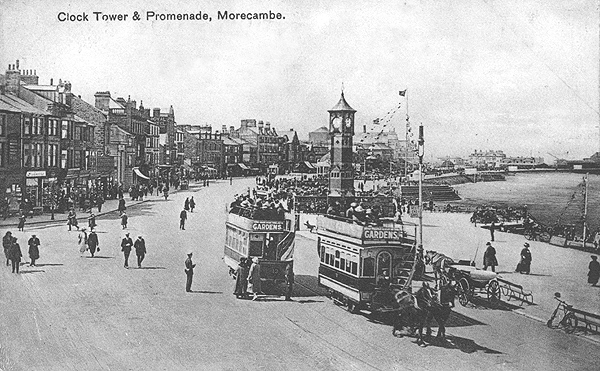
By this time the Corporation had doubled much of the trackwork. Such was the popularity of the tramway that it continued to make a profit for at least another decade. Two replacement horse cars – a double deck car numbered 13 and a single deck toastrack numbered 14 – were bought in 1919 from English Electric. A further two – a single deck toastrack numbered 15 and a double deck car numbered 16 – followed in 1922.

By this stage the writing was on the wall, as in 1919 the corporation had bought its first motor buses. Five years later it entered into an arrangement with the company to operate bus services jointly between Morecambe and Heysham. This led to the company closing down its tramway operations in October 1924. Nearly two years later, on 6th October 1926, the corporation also decided to close its tramway.

No Morecambe trams are known to have survived into preservation. The original horse car number 1, which dated back to 1887, was sold for £5 to Manchester Corporation so that it could appear in a Manchester Tramcar Pageant to depict the horse tram era as part of the Corporation’s Civic Week celebrations that took place 2nd to 9th October. However, the car was disposed of shortly after the processions were over.

This left just one remaining horse-drawn tramway operating on the British mainland – the company-owned Pwllheli and Llanbedrog Tramway – which survived for a further year until a ferocious storm on 28th October 2027 washed away a substantial section of the track.
Although the Morecambe Tramway has disappeared, it is still possible to view archival footage taken by the well-known chroniclers Mitchell & Kenyon as they journeyed by horse tram along the promenade from Central Pier to the Battery in 1901. This can be accessed on the British Film Institute website: https://replay.bfi.org.uk/video/090eafc6-3200-52e9-bc47-f26a0792e264
With thanks to Museum volunteer Jim Dignan for producing this article.
Image References:
Image 1: Lancashire Red Rose Collection website: https://redrosecollections.lancashire.gov.uk/view-item?i=276901
Images 2, 4, 6: National Tramway Museum collection
Image 3: Lancashire Red Rose Collection website: https://redrosecollections.lancashire.gov.uk/view-item?i=276902
Image 5: Local Transport History Library: https://www.lthlibrary.org.uk/index.html
Image 7: Ian Yearsley and Philip Grove (1988), The Manchester Tramways (the Transport Publishing Company), p. 262.