

27th September 2025 marks 200 years since the opening of the Stockton and Darlington Railway in 1825. On this momentous day, George Stephenson’s ‘improved locomotive engine’, ‘Locomotion No. 1’,

Image 1: Opening of The Stockton and Darlington Railway, 27 September 1825. Illustration for The Graphic, 13 October 1888. Engraving by J.R. Brown. Public domain image, source: http://content.answcdn.com/main/content/img/getty/3/7/3071037.jpg
The steam-hauled train included a passenger carriage – ‘Experiment’ – and more than thirty wagons, carrying a mixed load of coal and close to 600 passengers at speeds of up to 15 mph. This journey is thought by many to mark the birth of the modern railway system.
It wasn’t the first passenger railway service in the world – that honour is held by the Swansea and Mumbles Railway (then known as the Oystermouth Railway), which conveyed its first cargo of fare-paying passengers on 25 March 1807, having opened for the carriage of coal, limestone and iron ore the previous year.
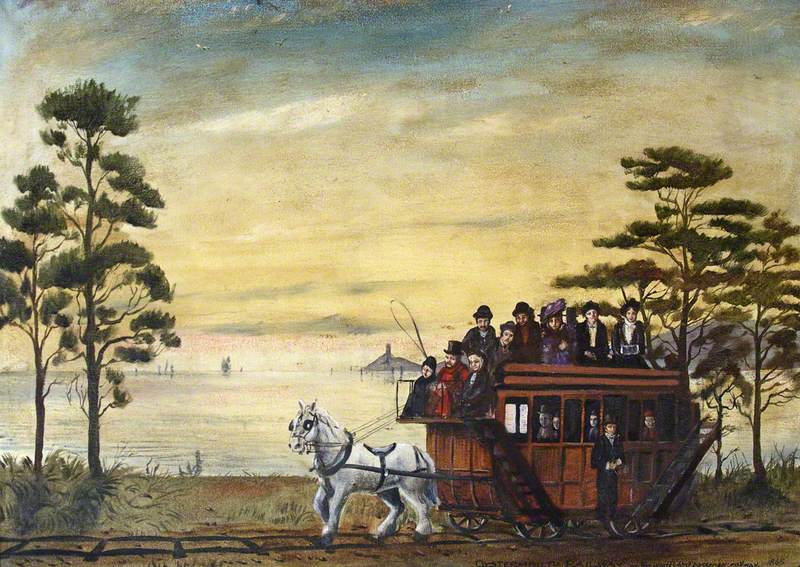
Image 3: The Oystermouth Railway by John Joseph Hughes. Credit: City & County of Swansea: Swansea Museum Collection. Source: https://artuk.org/discover/artworks/the-oystermouth-railway-224857/search/2025–keyword:oystermouth-railway–referrer:global-search
The use of steam locomotives – at Stephenson’s instigation – on the Stockton and Darlington line heralded a new transportation era in which people and places could be connected to one another at speeds that were unimaginable in the days of horse-drawn transport.
In 1830, George Stephenson was also responsible for building the Liverpool and Manchester Railway – the world’s first inter-city railway, and the first to rely exclusively on steam-driven locomotives. Ten years later, while engaged in the construction of the North Midland Railway, he came across deposits of coal at Clay Cross in Derbyshire and formed the Clay Cross Company to exploit them. Realising that the coal slack, which would otherwise go to waste, could be used to burn limestone, he then built his own lime kilns at Bullbridge and took out a lease on Crich Quarry (then known as Cliff Quarry) in order to supply them with fuel.

Image 5: Ambergate lime kilns. Source: http://www.crichparish.co.uk/indexwebpages/history.html
Quarry and kilns were connected by means of a wagonway that included a 550 yards self-acting incline at a slope of 1 in 5, known as The Steep, which was said to be the greatest in the country.
Crich Quarry had supplied limestone for iron smelting since it was opened by Benjamin Outram in 1791. The eastern end of it was subsequently bought in 1959 to provide a home for The Tramway Museum Society, which later became home to The National Tramway Museum.
Nor is this the only connection between the current site of the Tramway Museum and the evolution of Britain’s railways. In 1813, the Crich Quarry incline was the proving ground of the ‘Steam Horse’, a remarkable invention by William Brunton. Otherwise known as the Mechanical Traveller, it was designed to assist the five-ton steam locomotive up the steep incline with the aid of a pair of mechanical legs, whose feet gripped the ground behind the engine and helped propel it along at around three miles per hour.

Image 6: Brunton’s steam horse or mechanical traveller. Source: https://www.railengineer.co.uk/the-long-history-and-exciting-future-of-railway-systems-thinking/
Improbable though it sounds, the experiment seems to have been sufficiently promising to warrant the construction of a second, considerably larger, locomotive with a boiler of nine feet (nearly twice the size of its predecessor’s 5-foot boiler). This was put to work at the Newbottle Colliery in County Durham, where it was said to have hauled loads up a 1 in 36 gradient at 3 miles per hour in 1814 and 1815. Unfortunately, this locomotive was involved in a tragic accident when its newly wrought iron boiler exploded after its safety valves had been over-tightened. This incident – the first recorded boiler explosion – was also the first recorded railway disaster and, understandably, put an end to Brunton’s innovative design.
The world’s first street railway (or tramway, as it became known in Britain) – operated by the New York and Haarlem Railroad Company – opened in 1832. This was seven years after the Stockton and Darlington railway’s debut. Like most of the early tramways, this relied on horse-drawn tramcars. It was not until 1859 that the first steam-hauled tramcars appeared on the scene, though the heyday of the steam tram was during the final quarter of the nineteenth century.
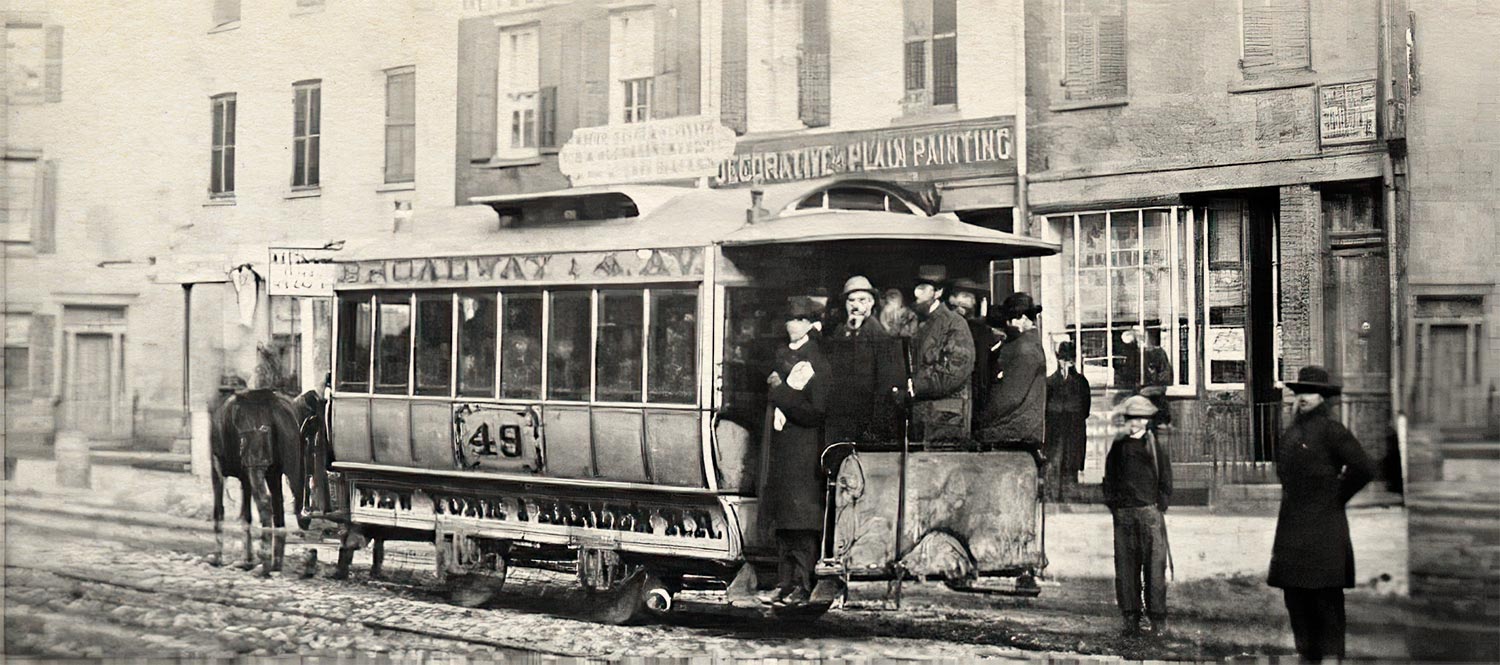
Image 7: The world’s first street railway, operated by the New York and Haarlem Railroad Company. Source: New York Courier and Enquirer: https://www.iridetheharlemline.com/2021/04/25/the-new-york-harlem-railroad-turns-190-images-from-the-early-years/
It was not until the widespread adoption of electric traction, around the turn of the century, that tramways began to become serious competitors to their steam-driven railway forebears in some urban areas. This prompted a number of main-line railway companies, including the North Eastern Railway, to electrify its coastal and inland suburban lines, the first of which opened on 29th March 1904. Days before, the Lancashire and Yorkshire Railway had electrified its Liverpool to Southport line, also in response to growing tramway competition.
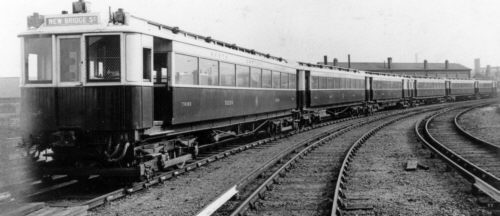
Image 8: North Eastern Railway Tyneside electric multiple units. The opening of the Newcastle electric tramway system in 1902 resulted in a loss of four million passengers from the NER – 40% of the 1901 total – and prompted the electrification of many of the latter’s competing train services. Source: https://www.lner.info/locos/Electric/ner_tyneside.php
As for the Tramway Museum itself, it owes its origins in the former Stephenson-operated Crich quarry site to the inception of the railway heritage movement at a time when Britain’s remaining tramways had all but disappeared. The founders of the Tramway Museum Society learned of Crich quarry’s existence in 1959 from members of the Talyllyn Railway Preservation Society, who were recovering track from Stephenson’s mineral railway at Crich for use on their own preservation project in Wales.
Image 9: View of the Stephenson mineral railway site from the quarry. Photograph: J H Price, 31 January 1959.
From these modest beginnings, the Museum has established a world-class collection of historic tramcars together with an operational tramway that demonstrates their operation to a new generation of visitors.
With thanks to Museum volunteer, Jim Dignan, for producing this article.
