


Not a lot is known about this particular tramcar beyond the fact that it served as a beach chalet in Hornsea for a time following its withdrawal from service. However, it is thought to have been an open-topped tramcar that was supplied to Hull City Tramways in 1903 by Milnes of Hadley, in Shropshire.
Although double deck steam trams had traditionally been covered (partly to protect passengers from steam and soot particles), the earliest double deck electric tramcars were exclusively open topped, as in this case. The most likely explanation for this seemingly backward step is that the protruding trolley standard would presumably have presented manufacturers of electric tramcars with tricky construction challenges.
While open topped tramcars were understandably popular during summer weather in coastal resorts, passenger demand in urban areas was greatest, not surprisingly, during wet and wintry weather. In conditions such as these, open top decks were decidedly off-putting, which effectively halved the useable seating capacity at times of maximum demand.
From very early on, therefore, the hunt was on for a satisfactory solution to this problem. The earliest attempts involved the use of temporary or removable top covers that could be dismantled when not required while affording better protection for upper deck passengers when conditions were inclement.
By 1902, the main phase of electric tramway construction in Britain was drawing to a close and the initial surge of orders for new tramcars had mainly been satisfied. It was at this stage that tramcar manufacturers began to turn their attention to the manufacture and sale of top covers to the operators of the massive fleets of open topped tramcars, in the hope of maintaining full order books.
Hull City Tramways was typical in this respect. By 1902 it had already acquired 100 open-topped double deck tramcars for its still expanding system, but the rate and size of new orders was slowing down. In 1903, 15 additional tramcars were required for the soon-to-be commissioned Hedon route. By this stage, however, many of the potential suppliers were offering a variety of top covers on new tramcars, which offered the prospect of increasing revenue potential during inclement conditions.
This posed a dilemma for the Tramways sub-committee, which had to decide whether to order the new tramcars in open-topped form or to justify the additional expense of ordering one of the new types of top cover that were becoming available and, if so, which one to specify.
Tenders were thus sought from no fewer than ten suppliers and, in the end, the successful tenders (from Milnes for the bodies with Brill trucks and Westinghouse motors and electrical equipment) made provision for a deferred decision with regard to the fitting of top covers until two months before the projected delivery date. The purpose of this was to enable the Corporation to test the merits of two different types of top cover that had been retro-fitted to some of its earlier cars.
In the end, the entire batch of tramcars was delivered in open-topped unvestibuled form, but with canopies and reversed staircases. However, they were all fitted with Magrini adjustable top covers before entering service between December 1903 and May 1904. The Magrini top cover could be folded away in good weather, which effectively converted the tramcar into a traditional open topped vehicle during the summer months.
Cars fitted with this equipment were supplied with double decency boards, which afforded a recess that could accommodate two sets of frames with canvas or windows. The roof consisted of two canvas awnings on sprung roller blinds, mounted either at the side or the centre of the upper deck.
This was only a temporary measure, however, as the entire batch of tramcars was converted to fixed top covers in 1907 and most were subsequently fitted with enclosed balconies and vestibuled platforms. The original reversed staircases (which caused visibility problems for the driver) were replaced by the standard variety at the same time.
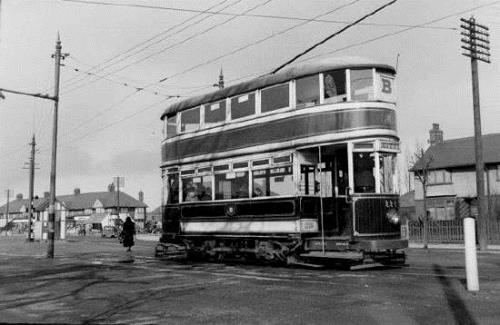
This particular tramcar was acquired for the Hedon Road route but, beyond that, not a lot is known about its operational history because, by the time its remains were discovered, in the 1970s, all traces of its fleet number had disappeared. However, it is thought to have survived to the end of the city’s tramway in June 1945, unlike many of its contemporaries, which were sold to Leeds Corporation.
It was presumably sold for scrap and the lower saloon, shorn of its upper deck, trucks and electrical equipment, ended up as a beach chalet in Hornsea. Following its discovery, the remains were taken to the museum’s off-site storage facility. For a time it was ear-marked for a significant restoration project: to fill a major gap in the museum’s collection, consisting of a transitional phase in the evolution of tramcars between open-topped and fully enclosed double deck tramcars.
The original plan was to unite the Hull lower tram body with a short top cover belonging to a Sheffield tram; but the subsequent discovery of an authentic Sheffield lower deck in Gateshead caused a change of plan and the resulting restoration project eventually gave rise to Sheffield 74.
This rendered the Hull body redundant, at least for the time being, though it is not beyond the bounds of possibility that it could be pressed into service as part of a future restoration project.
There is, for example, another transitional top-covered tramcar that is also missing from the national collection, known as a Bellamy tram. This was a rigid top cover (unlike the Magrini adjustable cover) that just enclosed the upper deck seating area, leaving the balconies and stairways exposed to the elements;

A restoration project of this kind, however, would be hugely ambitious and extremely expensive, and so is unlikely to materialise unless there is a major injection of external funding.